

The science behind the operatic voice was the title of the lecture given by Rubén Picó (Professor of Applied Physics – Acoustics, Polytechnic University of Valencia, Gandia Campus) as part of the course “Opera, a complex organism: how it was born, how it operates and how it has evolved to the present day,” organized by the Nau Gran of the University of Valencia in collaboration with Les Arts, Valencia.
The session addressed the operatic voice from a scientific perspective, analyzing what happens physically when a singer projects their voice in a theater, how it interacts with the architecture of the hall, and why certain spaces enhance the artistic experience. Through accessible explanations and participatory experiments, the audience was able to understand concepts such as resonance, projection, directivity, and natural acoustic reinforcement, connecting the physics of sound with musical emotion.
The activity combined a lecture and a technical visit to the Aula Magistral, allowing participants to observe the acoustic characteristics of the space in situ and reflect on how architectural design influences the perception of the voice and the orchestra. This practical approach facilitated a direct understanding of the relationship between science, architecture, and aesthetic experience.
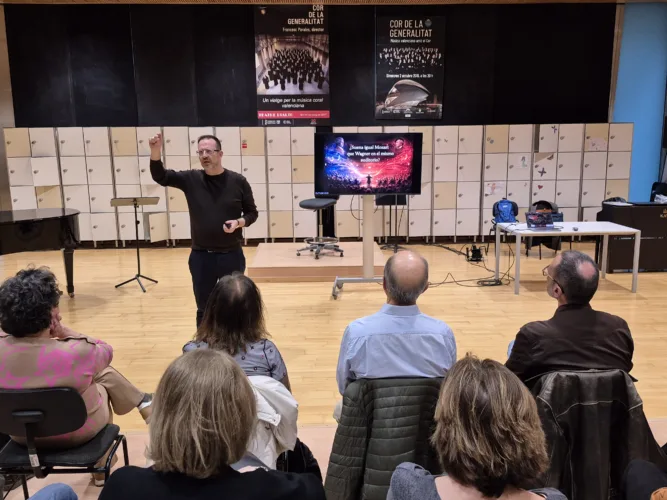
The talk is part of Rubén Picó’s work at the UPV in the field of musical acoustics and scientific dissemination, and is directly linked to the Science and Music project, which promotes dialogue between research, artistic creation, and the transfer of knowledge to society. The session highlighted how opera is not only a theatrical performance, but also involves physics, engineering, acoustic design, and science applied to art.
The event brought together a particularly engaged audience, interested in understanding opera not only from its historical and artistic dimensions, but also from its material and scientific foundations, thus reinforcing the interdisciplinary nature of the course.