

In recent years, university classrooms have begun to transform. They are no longer just spaces where knowledge is transmitted, but places where people experiment, debate, and take action. A revealing example of this evolution can be found in the work of Sandra Martorell and M. Rosario Sáez-Salvador, who have explored how performance can become a powerful tool for educating, raising awareness, and promoting social change from within the university.
Their proposal is based on a simple but profoundly transformative idea: art is not only taught, it is also lived. And when that experience is directed towards social problems—in this case, gender-based violence—the educational effect goes far beyond theory.
Artivism: when art takes to the streets to raise awareness
Artivism, the fusion of art and activism, is not new, but it has gained renewed strength in the last decade. In the 1970s, collectives such as Guerrilla Girl and current actions such as Las Tesis’ Un violador en tu camino (A Rapist in Your Path) have demonstrated the political and communicative impact of these practices.
The work analyzed here takes up this tradition and transfers it to the educational sphere: students not only learn what feminism is or what types of violence exist, but also investigate, represent, and combat them through the body and artistic expression.
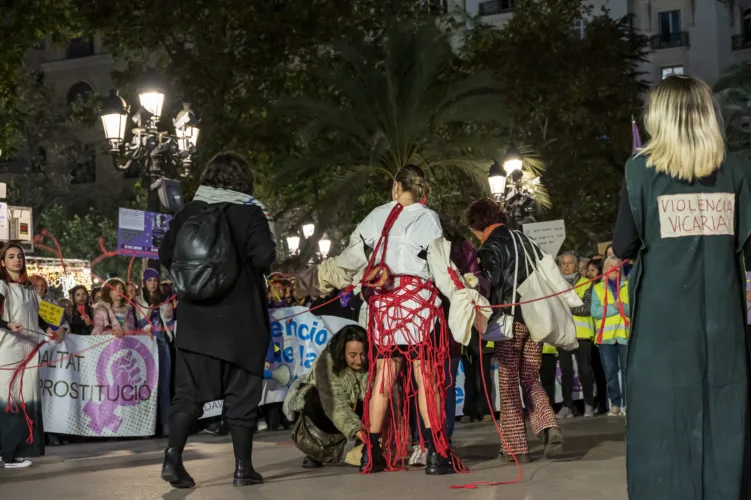
Photo: Pedro Llorente Alemany
A creative process that becomes transformative learning
Over several weeks, students at the Escola d’Art i Superior de Disseny de València follow a process that combines research, ideation, creation, and public action. It is not just about creating a performance, but about collectively understanding:
• what forms of violence women suffer,
• how they are culturally reproduced,
• and how art can open up spaces to denounce and rethink them.
The methodology—Arts-Based Research—turns the classroom into a collective laboratory where feminist theory, design, and creativity come together.
The result: artistic actions in public spaces on November 25 that challenge those who observe them, but above all have an impact on those who perform them.
Five performances to open our eyes
Among the actions carried out, the following stand out:
• The Tunnel of Violence
An immersive installation where the audience walks through a corridor filled with sexist messages, to feel firsthand the discomfort that women experience on a daily basis.
• REDiseñándonos (Redesigning ourselves)
A photographic mosaic that composes a new collective female face, accompanied by a haka-style performance celebrating the strength and resilience of women.
• 1027
A bride locked in an urn: each garment or inscription on her dress names a woman murdered that year. The public throws dirt on the urn, symbolizing the weight of patriarchal discourse.

Photo: Ana Ferrándiz
• Golgotha
A symbolic Way of the Cross on the school façade, where each station represents a form of gender-based violence.
• Desnugant la violència (Untangling Violence)
A student surrounded by six personified forms of violence; the audience, invited to “untie” these bonds, symbolizes the collective possibility of breaking the cycle.
These actions not only denounce, but also create community, generate reflection, and emotionally mobilize both participants and spectators.

Photo: Pedro Llorente Alemany
Impact on students: more than a subject, a life experience
The testimonies collected speak for themselves:
• 100% of students consider this training essential for their professional future.
• More than 90% understand design as a tool for social justice after the project.
• Almost half became involved in equality projects outside the classroom after these experiences.
• For many, the performance meant empowerment, awareness, and action:
“We are not alone; we have an army of sisters,” declared one student.
This shows that these projects not only teach but also transform.
Conclusion: to educate is also to mobilize
The work of Martorell and Sáez-Salvador brings a fundamental idea to the table:
when education incorporates the body, art, and collective action, learning becomes an experience that transcends the classroom and projects itself into society.
Performance, in this context, is not just an artistic practice:
it is a pedagogical, political, and emotional tool for:
• questioning hegemonic discourses,
• denouncing sexist violence,
• strengthening empathy and cooperation,
• and training young people to imagine and build more just worlds.
Because educating with art is a powerful way to transform reality.
Full article available at: https://link.springer.com/chapter/10.1007/978-3-031-99090-8_11
Cover photo: Ana Ferrándiz