
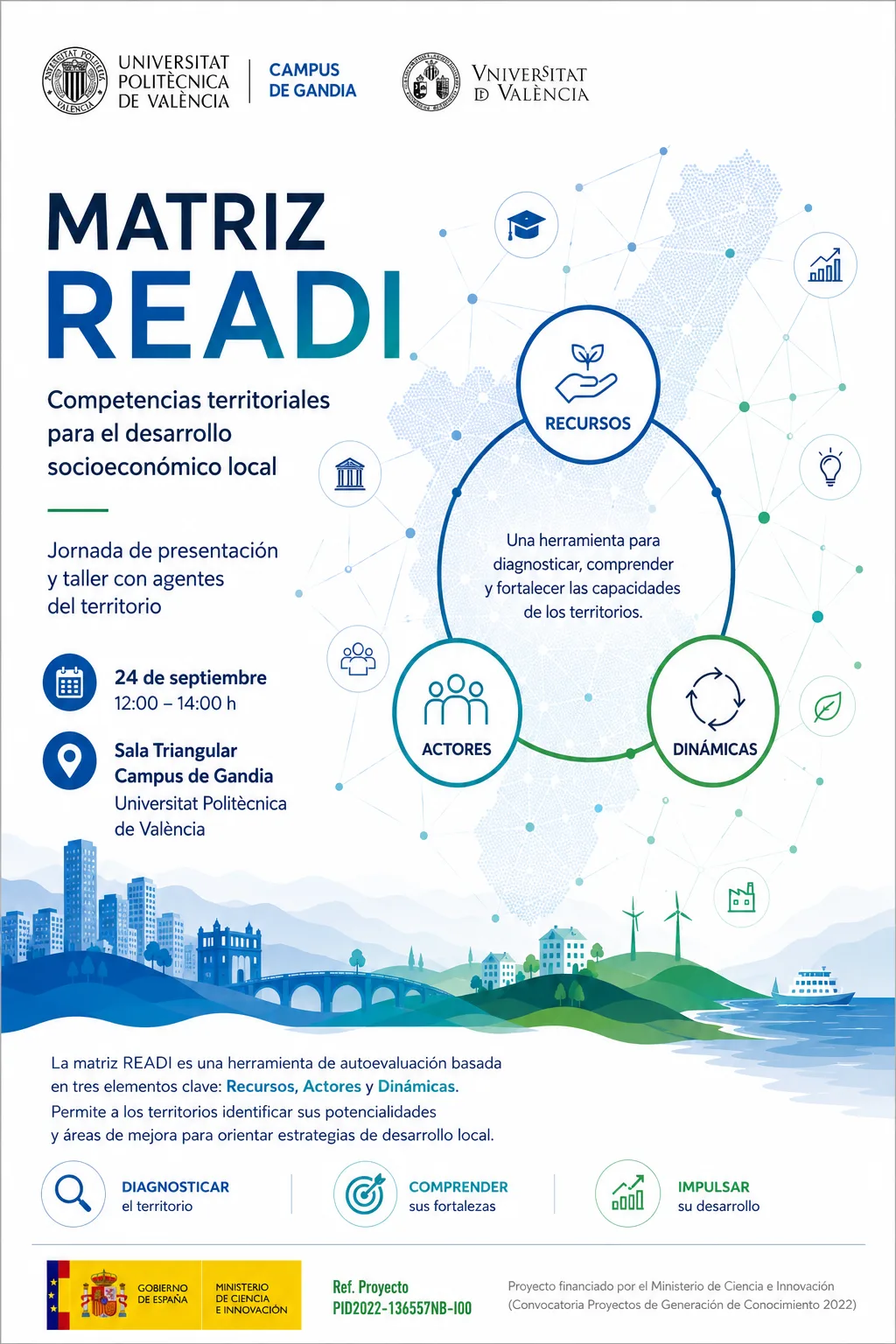
On September 24th, the Gandia Campus of the Universitat Politècnica de València (UPV) will host an open workshop dedicated to territorial development and social innovation. Researchers from the Gandia Campus will present the results of the READI® Matrix Project (Resources + Actors + Dynamics), a research initiative that seeks to improve knowledge of territories and strengthen their capacity to face future challenges.
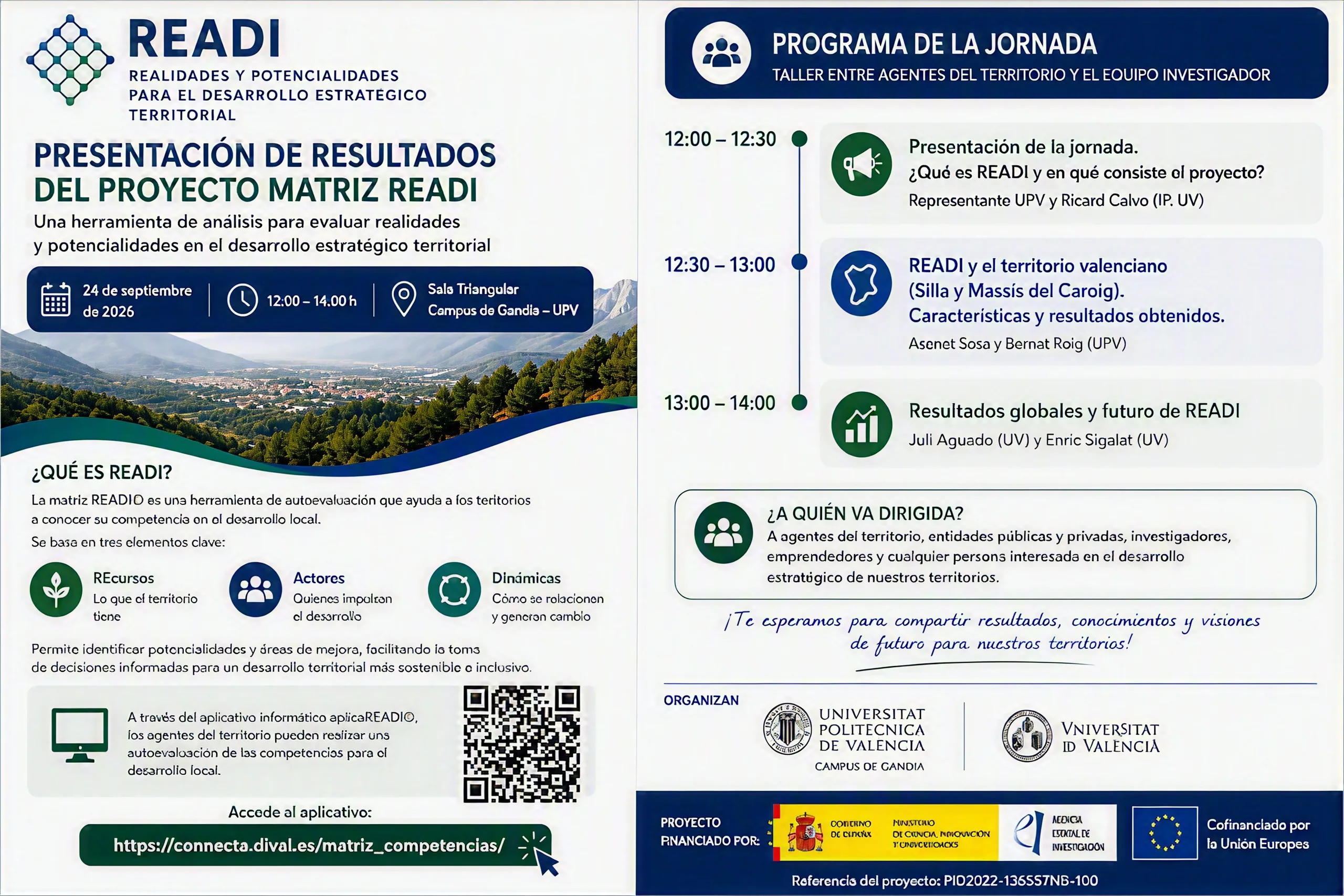
The workshop will feature the participation of Bernat Roig, a researcher at the IGIC Institute on the Gandia Campus, and Asenet Sosa, from the UPV’s Department of Urban Planning, who will share the main conclusions obtained during the project’s development in the province of Valencia and demonstrate the possibilities of a tool designed to facilitate territorial self-assessment. A better understanding of the territory leads to better decision-making.
In a context marked by significant economic, social, and environmental challenges, territories need tools that allow them to accurately understand their strengths, weaknesses, and development opportunities. The READI® Matrix Project, funded by the State Research Agency, was created precisely for this purpose: to offer a self-assessment model that helps municipalities, regions, and other territorial areas analyze their capacity to promote sustainable local development processes adapted to their specific circumstances.
READI’s methodological approach is based on the integrated evaluation of three key dimensions. The first is the resources, both tangible and intangible, available in a territory. The second is the actors, that is, the organizations, institutions, businesses, associations, and individuals who participate in economic and social life. Finally, the third dimension is the dynamics, understood as the relationships, collaborations, and processes that enable the activation of these resources through interaction among the different actors.
According to the researchers, analyzing these three elements together provides a more complete view of the territorial reality and allows for the identification of fundamental aspects for designing more effective and participatory development strategies.
Results obtained in the province of Valencia
During the event, the main analyses carried out by the UPV team in different areas of the province of Valencia will be presented. These studies have validated the READI methodology and confirmed its usefulness in understanding the level of preparedness of territories for processes of change, economic transformation, or strategic planning.
In addition to presenting the research results, participants will have the opportunity to learn firsthand about the @plicaREADI web application, developed to facilitate territorial self-assessment. This tool allows for the systematic collection of information and the generation of diagnoses that support decision-making by public administrations, local development agents, social entities, and other stakeholders involved in territorial management.
This initiative represents an example of how university research can generate practical tools with a direct impact on society, bringing scientific knowledge closer to the real needs of territories and contributing to improving their governance and adaptive capacity.
An Open Day for the Community
The presentation will take place on September 24, 2026, from 12:00 to 2:00 p.m., in the Triangular Room of the Gandia Campus of the UPV (Universitat Politècnica de València). Attendance is free and open to the university community, local development professionals, institutional representatives, associations, and anyone interested in learning about new tools for understanding and strengthening local communities.
With this event, the Gandia Campus reaffirms its commitment to knowledge transfer and the generation of innovative solutions to current social and territorial challenges. The event will offer an opportunity to learn about a pioneering methodology, exchange experiences, and reflect on how the resources, stakeholders, and dynamics of a region can become drivers of development and well-being for its citizens.