
The initiative “I’m bringing a scientist to my school” brings the work of women researchers closer to students of all ages.
To mark February 11, International Day of Women and Girls in Science, the Gandia Campus is once again celebrating the “I’m bringing a scientist to my school” initiative, organized by its Equality Committee with the support of the IVIO Chair. This activity, now in its eighth year, will take place throughout February in various schools in La Safor and other regions.
In 2026, the national focus of 11F is on a highly topical issue: gender bias in artificial intelligence (AI). This technology, which is present in fields as varied as medicine, education, and justice, is not neutral. Algorithms learn from the data they receive, and if this data reflects social inequalities, they can perpetuate or even amplify them. Biases can appear at different stages: from training data to model design or the composition of the teams that create the technology.
These biases are not just a technical problem; they have real consequences in everyday life. Recent studies show that they affect access to employment, health diagnoses, judicial decisions, and financial credit, conditioning opportunities and outcomes. Therefore, educating children from an early age about critical thinking and stereotype detection is essential, and increasing the presence of women in STEAM careers is key to ensuring that technology reflects the diversity of society.
Presence of female scientists in classrooms
“I’m bringing a female scientist to my school” brings female researchers and professionals from different fields—science, technology, engineering, arts, and mathematics—to interact with students in early childhood education, elementary school, middle school, high school, and adult education. The initiative seeks to showcase the real work of female scientists and bring their professions closer to students, offering role models that break gender stereotypes.
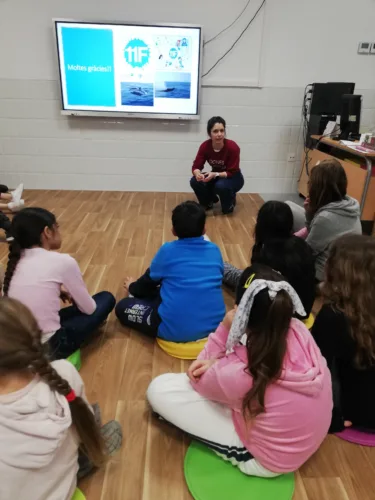
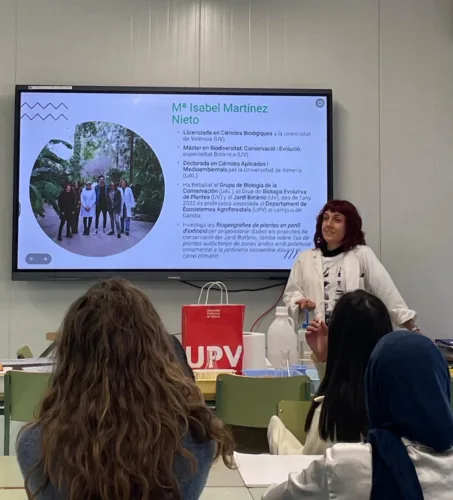
Recognizing and highlighting the work of women in science remains a challenge: female role models are still scarce in many classrooms. Having these figures inspires girls and teenagers, broadens their professional horizons, and helps overcome social barriers.
Highlights for 2026
- Underwater acoustics – Isabel Pérez Arjona, IES Vall de la Safor, Vilallonga (February 9)
- What do you want to be when you grow up? – Chemistry workshop, Josepa Costa Murcia and Sagrario Torres Cartas, CEIP Les Foies, Grau de Gandia (February 9)
- Anthotography – Workshop with Sandra Martorell Fernández, CEIP 8 de Marzo, Valencia (February 9 and 11)
- Chemistry and Biology Workshop – Isabel Martínez Nieto and Sagrario Torres Cartas, CEIP Cervantes, Gandia (February 10)
- Why do we need a 11F? It’s not magic, it’s chemistry, talk and workshop – Josepa Costa Murcia and Sagrario Torres Cartas, San José de la Montaña School, Oliva (February 11)
- Who invented it? – Ana González Suárez, Les Foies Primary School (February 11) and Borja School, Gandia (February 13)
- Investigating the sea: science in the feminine – Silvia Falco Giaccaglia, CFPA Xàbia (February 12)
- Water management and endangered species – Maite Sebastiá Frasquet, IES Montdúver, Xeraco (February 13)
- Between algorithms and data: applications of linguistics – Eva Mestre Mestre, CFPA Jaime I, Gandia (Feb. 18)
- Female role models and fun chemistry – Josepa Costa Murcia and Sagrario Torres Cartas, CEIP Ausiàs March, Rafelcofer (Feb. 20)
- Women and science / Science with colored pencils – Virginia Garófano Gómez, CEIP Les Foies, Grau de Gandia (Feb. 20)
- Discovering science – Isabel Pérez Arjona, CRA Alfauir-Ròtova (Feb. 23)
In addition, the Gandia Campus Library has selected books and comics that highlight the achievements of women in science, from pioneers to current scientists. These materials will accompany the experts during their visits, offering students relatable and inspiring role models.