

In recent years, podcasts have established themselves as one of the key formats within the digital ecosystem, not only in the fields of entertainment and journalism, but also in cultural and institutional communication. This is the context for the research article recently published in the journal Disertaciones (vol. 19, no. 1), which analyzes the role of podcasts as a strategic communication tool in museums, based on a case study of the Thyssen-Bornemisza National Museum.
The research, authored by Raúl Terol-Bolinches (Polytechnic University of Valencia), professor at the Gandia Campus, and Julio González-Liendo (Universidad del Diseño, Innovación y Tecnología), is based on a clear premise: 21st-century museums can no longer be understood solely as spaces for contemplation, but as active agents of communication, dialogue, and citizen participation. The acceleration of digitization, especially after the COVID-19 pandemic, has prompted these institutions to explore new formats capable of bringing art and heritage to diverse audiences. Among these, podcasts stand out for their ability to generate intimate, accessible stories that are deeply connected to the listener’s experience.
The article provides an in-depth analysis of the three podcasts produced by the Thyssen-Bornemisza Museum—Thyssen, the official podcast of the Thyssen-Bornemisza Museum; Sororas. Antiguas pero modernas (Sisters. Ancient but modern); and Las paredes hablan (The walls speak)—combining a content analysis based on the Close Analytical Listening technique with semi-structured interviews with those responsible for them. This mixed methodological approach allows for an examination of both the narrative and sound characteristics of the episodes and the motivations, objectives, and challenges behind their production.
The results reveal a strategic use of podcasts as a means of humanizing the institution, making traditionally invisible internal processes visible, and connecting art with contemporary social debates such as historical memory, feminism, colonialism, and LGTBI identities. Far from being limited to cultural dissemination, these audio projects contribute to reinforcing institutional transparency and building a closer, more emotional, and dynamic relationship with the public.
The study also highlights the potential of podcasts to diversify audiences and democratize museum discourse by incorporating multiple voices—curators, educators, artists, curators, and experts—and embracing polyphonic narratives that break with traditional communication models. Although challenges remain in terms of measuring impact and direct audience participation, the research confirms that podcasts have become a key tool in the digital strategy of contemporary museums.
A book to map communication in the digital society
This research on podcasts as an emerging format and their ability to articulate new cultural narratives is part of a broader reflection on how meaning is communicated, designed, and produced in the digital society, a line of inquiry that connects directly with another recent academic publication coordinated by professors Raúl Terol, Paloma Rodera (Universidad Europea de Madrid), and Gonzalo Fuentes (CEU San Pablo). The book is entitled Cartografía de la comunicación: un viaje por el diseño, la inteligencia artificial y la sociedad digital (Dykinson, 2025), a collective work that offers an interdisciplinary overview of some of the major challenges and opportunities facing communication today.
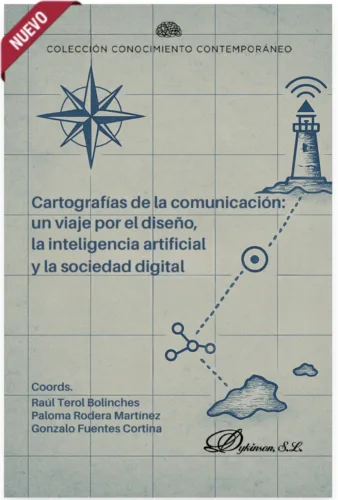
The book brings together contributions from researchers and professionals who analyze, from different perspectives, the impact of design, artificial intelligence, and digital technologies in areas such as education, culture, journalism, and artistic creation. Conceived as a critical cartography, the work invites us to rethink communication as a space for experimentation, social responsibility, and innovation, in line with the debates addressed in research on podcasting and museums.
With these two publications, the Gandia Campus reinforces its commitment to research in communication, digital culture, and emerging narratives, contributing to the academic and social debate on how we tell stories, listen, and construct meaning in a world increasingly mediated by technology.